
AI Face DNA Test Online Free: Family Facial Resemblance Analysis
Compare family photos with on-device AI to discover your closest look-alikes and feature balance in seconds. Visual resemblance only — not a biological DNA, paternity, or kinship test.
Interactive Family Facial Resemblance Tool
AI Face Resemblance Check
Compare family photos with on-device AI to see visible facial likeness. Visual resemblance only — not a DNA, paternity, or kinship test.
Visual Resemblance vs. DNA
This tool compares visible facial geometry (eye spacing, nose contour, lip volume, jaw taper) across photos. It cannot determine genetic relationships, biological inheritance, or paternity.
Photo Guidelines
Front-facing portraits with neutral expressions and balanced lighting produce the most reliable results. Tilts, heavy shadows, and wide smiles can alter visible proportions.
Privacy & Data Security
All facial landmark detection and comparisons execute inside your browser's memory using WebGL. Your photos are never sent to our servers or stored remotely.
Pick a relationship — they join your family tree in the right place.
Recent checks
Last 5| Type | Result | Score | Time |
|---|
Technical Specifications & Processing Architecture
FacePair executes high-dimensional facial geometry extraction locally inside your browser runtime.
- Execution Environment
- 100% Client-Side In-Browser (HTML5 Canvas & WebGL / Wasm)
- Landmark Coordinate System
- 468 Three-Dimensional Coordinate Nodes (MediaPipe FaceMesh)
- Feature Vector Embedding
- 1,024-Dimensional Facial Geometry Vector (FaceRes Model)
- Primary Geometric Metrics
- Inter-Pupillary Distance, Nasal Bridge Ratio, Mandibular Curvature, Cheekbone Proportions
- Data Security & Storage
- Zero Cloud Uploads (Tensors purged immediately upon session reset)
- Functional Classification
- Recreational Phenotypic Resemblance Analysis (Non-Medical, Non-Forensic)
How the FacePair AI Facial Resemblance Scan Works
FacePair analyzes facial geometry across four automated, client-side steps.
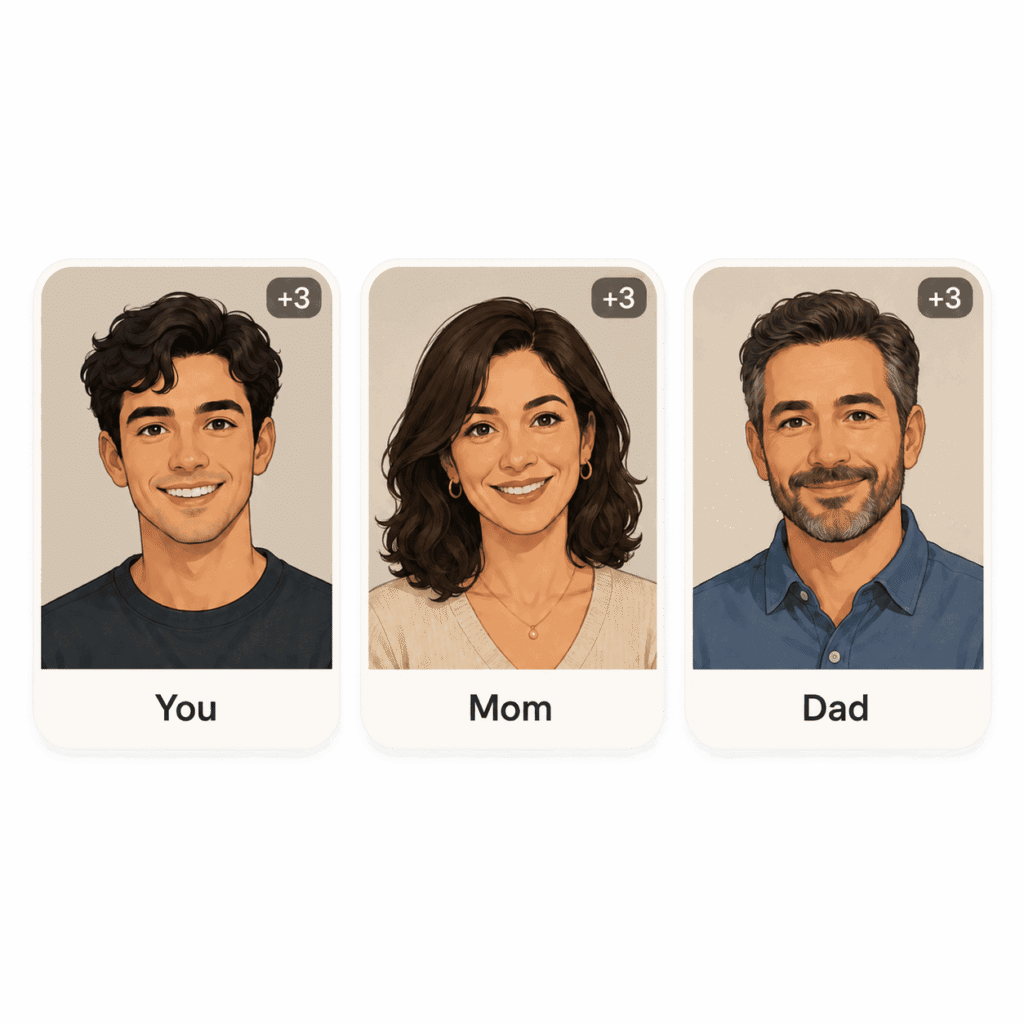
Upload Photos of Yourself and Your Parents
Select front-facing portraits of yourself, your mother, and your father. Adding well-lit photographs with neutral facial expressions ensures optimal landmark detection precision.
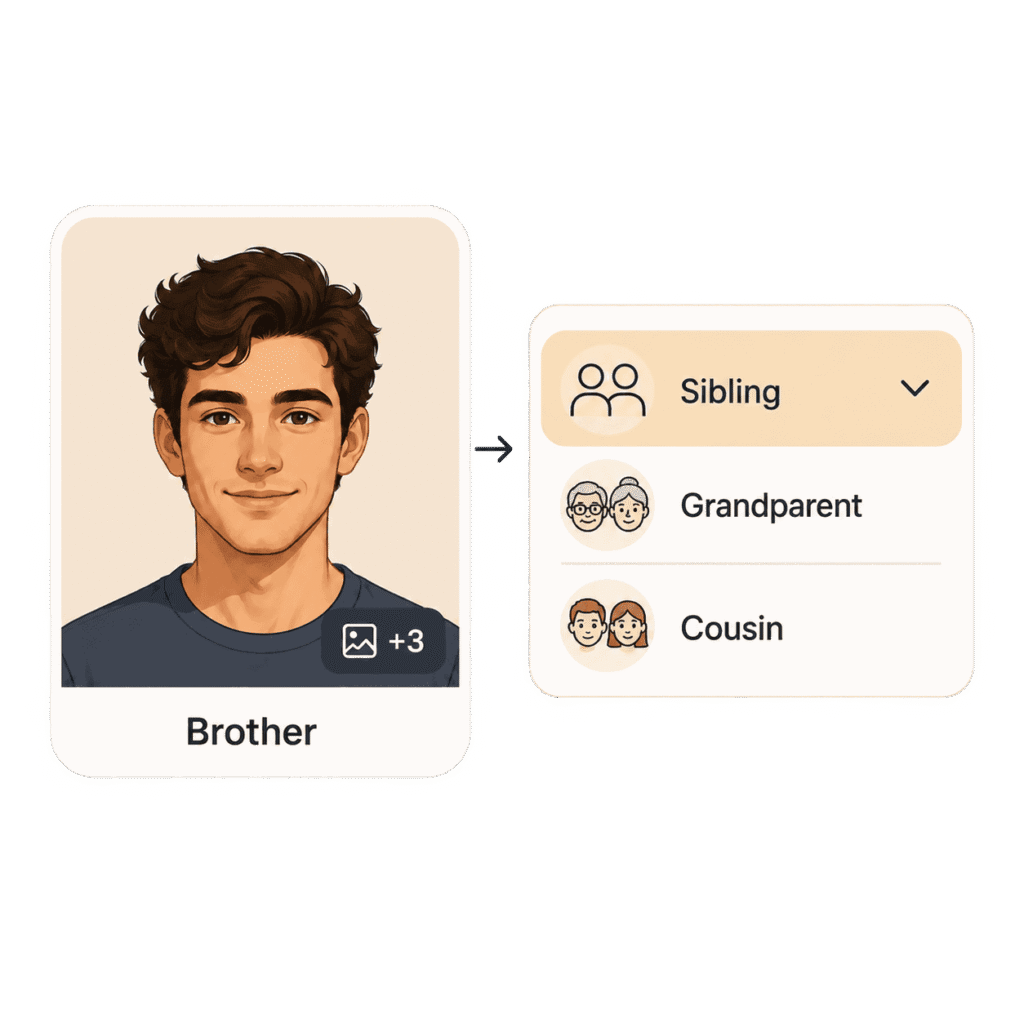
Add Extended Relatives to Your Family Tree
Expand your comparison beyond immediate parents by adding siblings, maternal grandparents, paternal grandparents, aunts, uncles, and cousins to the structural family layout.
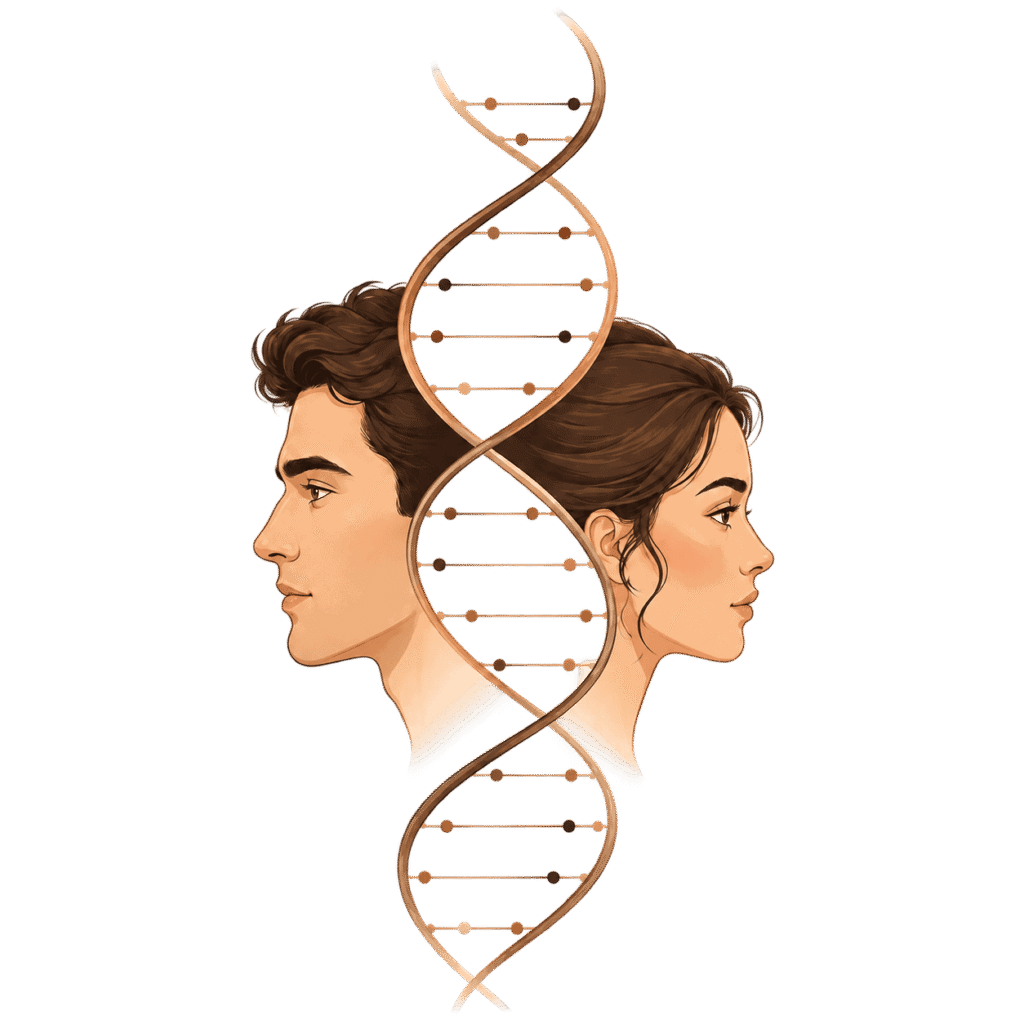
Run the Neural Biometric Face Scan
Trigger the client-side neural network to map 468 coordinate nodes across eye spacing, nasal bridge angles, mandibular contours, and lip perimeters within seconds.
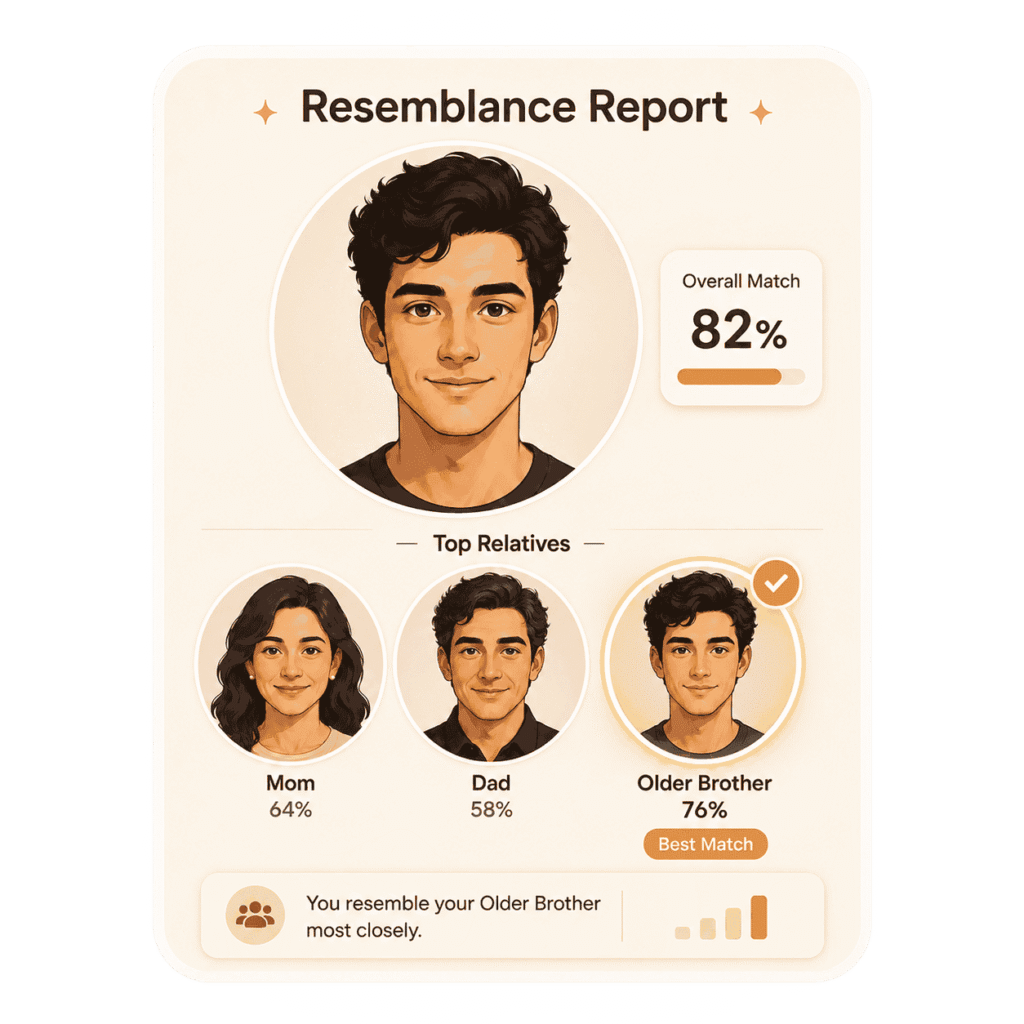
Review Your Detailed Resemblance Report
Examine your normalized Mom vs. Dad visual balance split, independent relative likeness scores, and feature-by-feature geometric alignment across your entire family tree.
Face DNA Test vs. Laboratory Genetic DNA Test
Review the structural differences between photo-based phenotypic analysis and clinical molecular genetics.
| Evaluation Property | FacePair AI Face DNA Test | Clinical Laboratory DNA Test |
|---|---|---|
| Primary Input Required | Digital front-facing photographs | Biological buccal swab (saliva) or blood draw |
| What the Test Analyzes | Visible 3D facial geometry (468 landmarks) | Short Tandem Repeat (STR) genetic loci & chromosomes |
| Legal & Paternity Validity | Zero legal standing (Recreational look-alike only) | Legally binding with court-admissible chain of custody |
| Turnaround Speed | ||
| Financial Cost | 100% Free daily scans online | $120 to $450+ per clinical test |
| Data Privacy & Security | 100% Private (Processed in browser RAM, never stored) | Physical genetic sequence archived in external lab database |
| Biological Kinship Accuracy | Calculates visual resemblance only (Not biological inheritance) | 99.999% accurate for biological parentage confirmation |
| Summary: FacePair offers rapid, zero-cost recreational family look-alike comparisons. For legal, medical, or conclusive biological paternity determinations, use an accredited clinical DNA testing facility. | ||
FacePair Family Resemblance Features & Capabilities
FacePair organizes family portraits across years, lighting conditions, and generations to reveal how facial traits carry through your lineage.
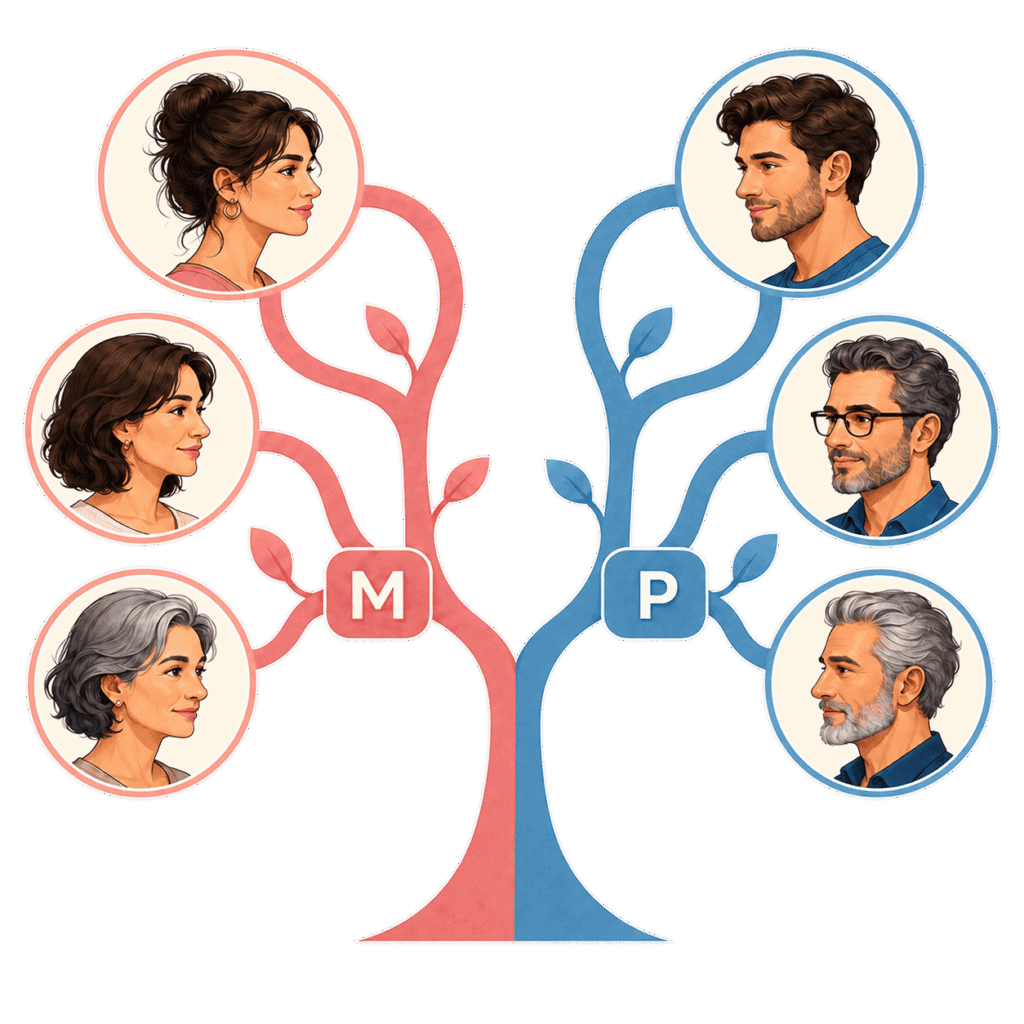
Organize Every Relative by Family Branch
FacePair automatically maps each individual to their corresponding maternal or paternal lineage. Parents, grandparents, siblings, aunts, uncles, and cousins remain organized in their genealogical branch, keeping multi-generational scans clear and navigable.
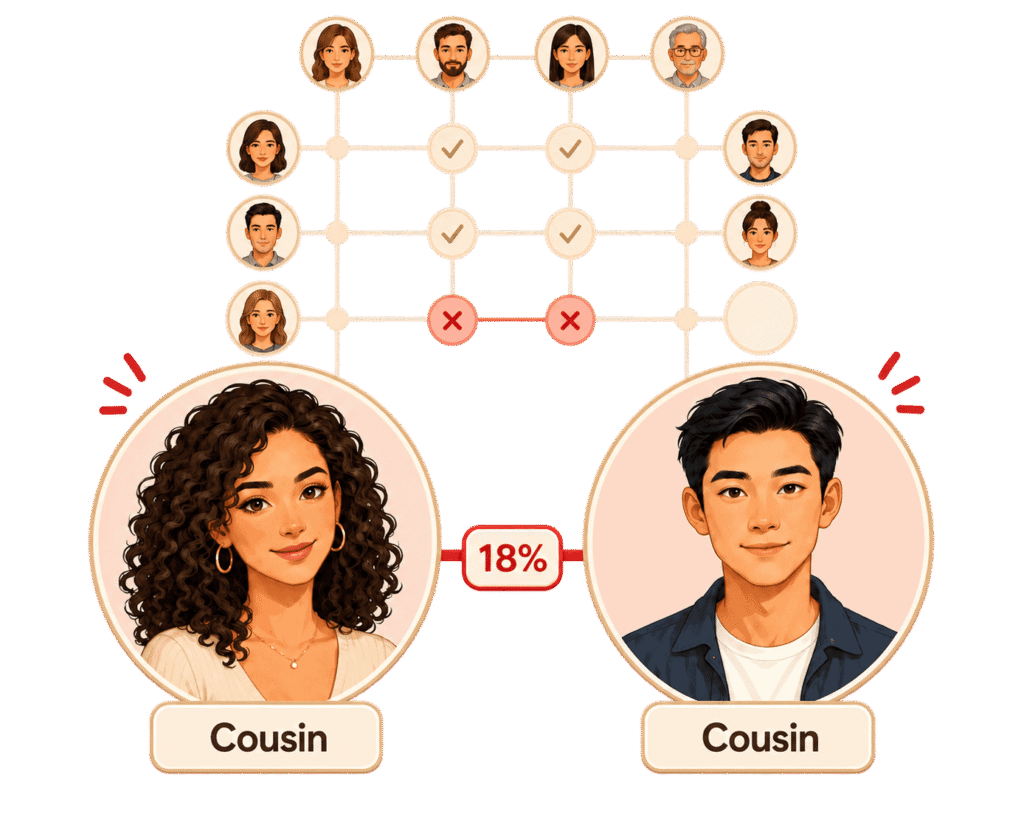
Explore Resemblance Beyond Parent-Child Matches
FacePair plots every uploaded portrait onto a comprehensive all-vs-all resemblance matrix. The engine computes similarity scores across every relative pairing simultaneously, enabling you to inspect sibling-to-sibling, cousin-to-cousin, and aunt-to-niece likeness in a single scan.
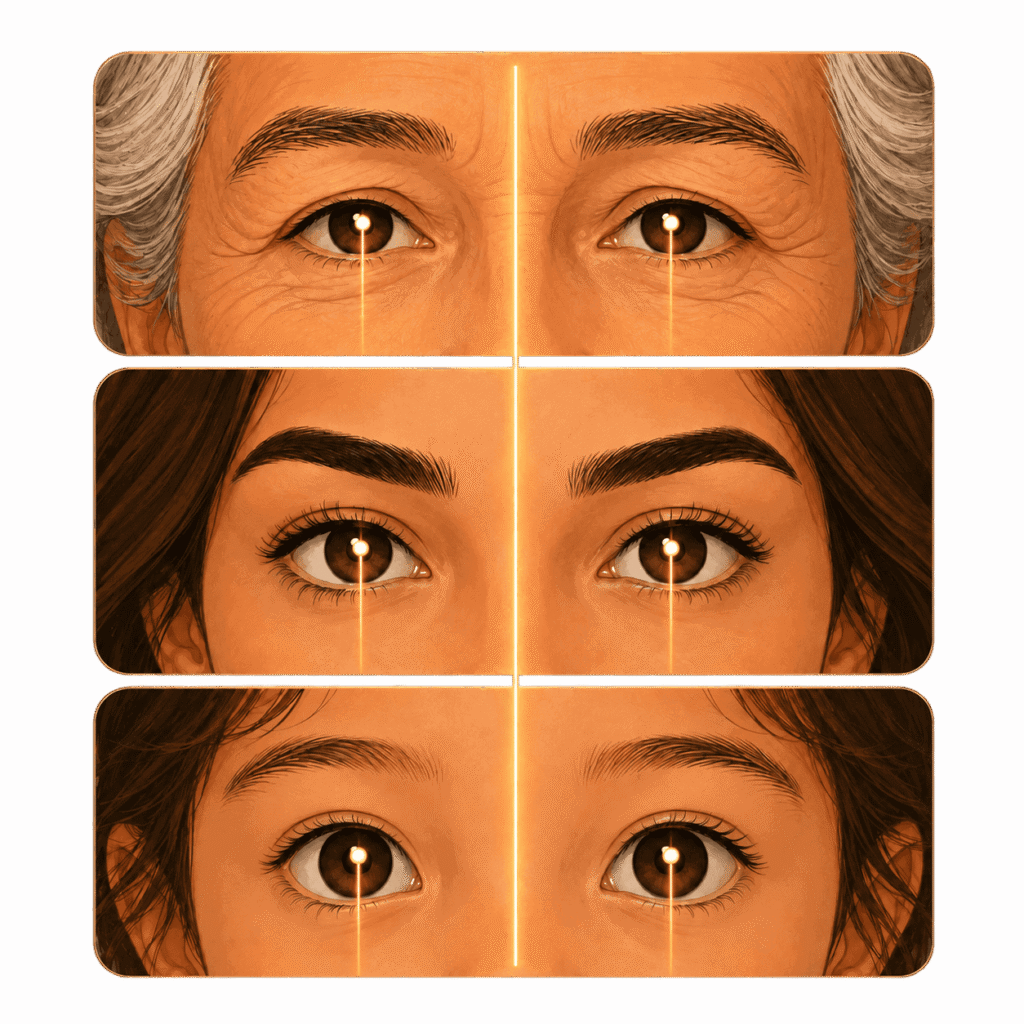
Trace Individual Facial Features Across Relatives
Isolate specific feature zones — such as eye contours, nasal bridge width, cheekbone prominence, or jawline curvature — and evaluate them across your entire family tree. FacePair identifies recurring phenotypic structural patterns that casual visual inspection often misses.
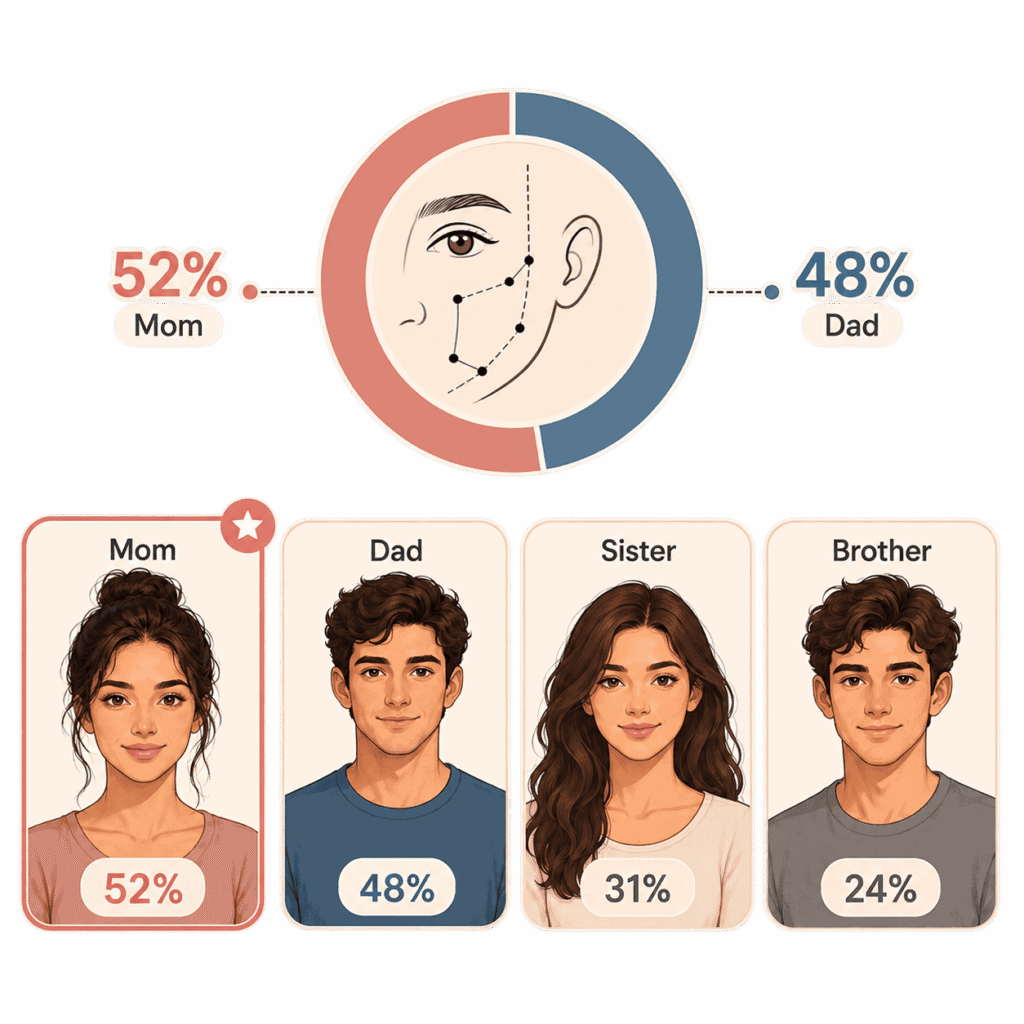
Scored and Ranked Results for Every Family Match
FacePair delivers a normalized Mom vs. Dad likeness balance split alongside a ranked leaderboard of your closest look-alikes. Every relative receives an indexed score from 0 to 100 with clear qualitative interpretations, providing immediate clarity on your strongest family matches.
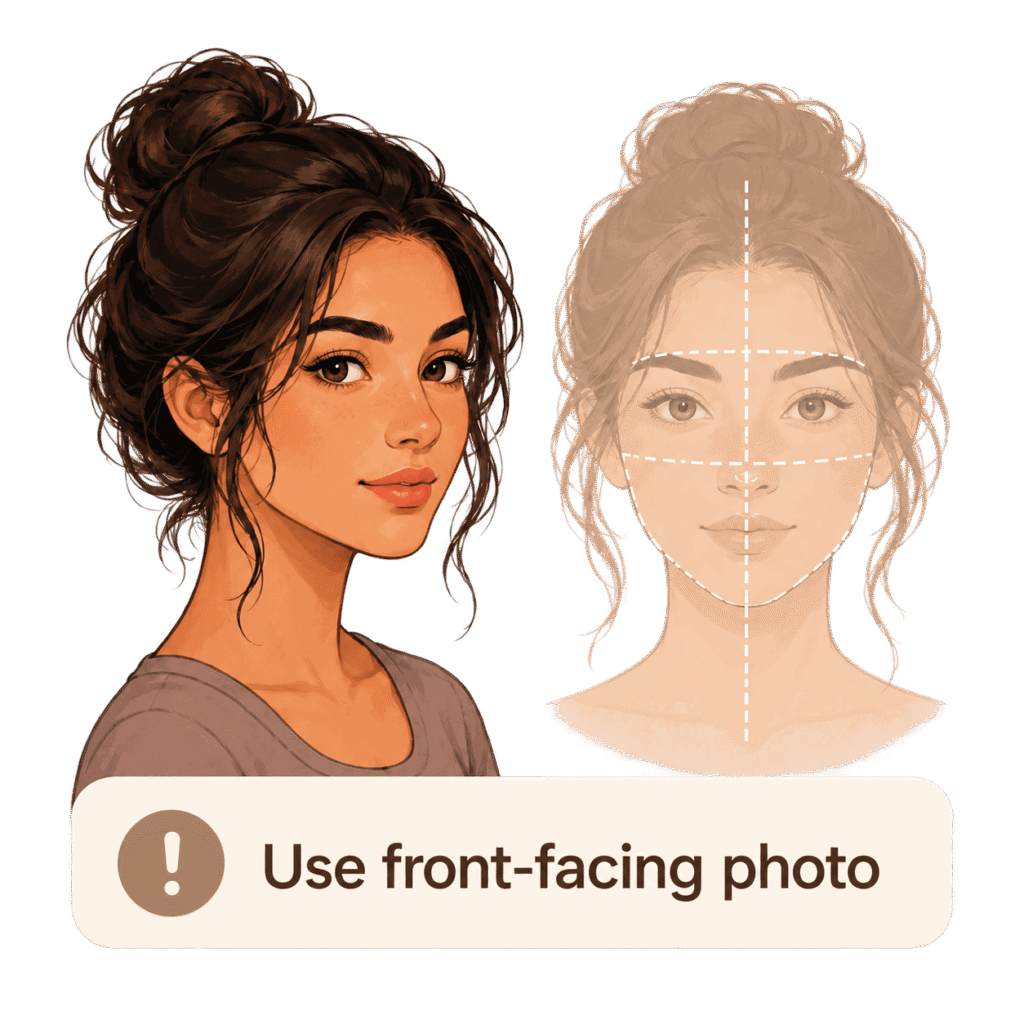
Per-Photo Quality Ratings and Actionable Feedback
Every photo undergoes automatic quality validation that assesses sharpness, illumination balance, tilt angles, and occlusions. The diagnostic panel flags potential issues and provides actionable guidance, ensuring your photos deliver maximum landmark extraction accuracy.
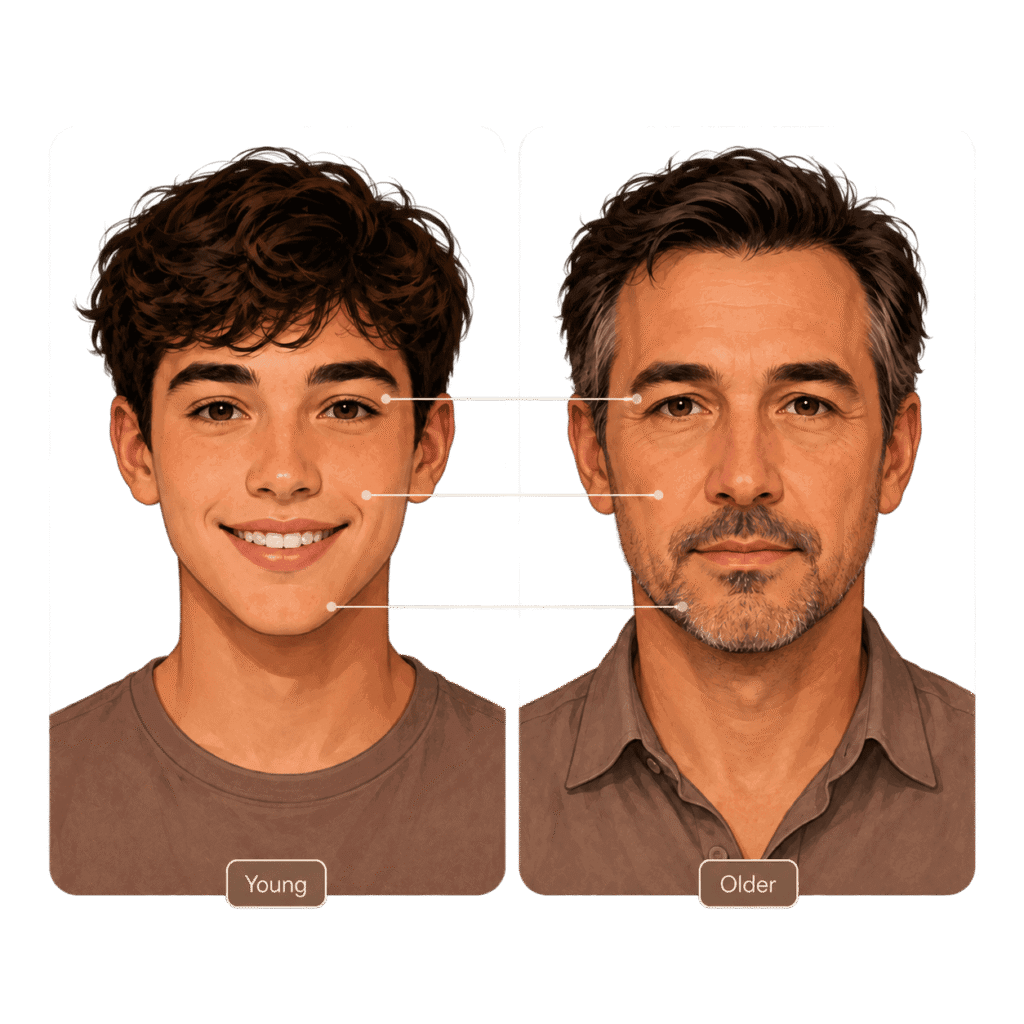
Match Faces Across Different Ages and Expressions
FacePair evaluates underlying 3D bone geometry and proportional landmark ratios rather than surface color or transient skin texture. This geometric approach ensures that smiles, natural aging lines, and multi-decade age gaps between generations do not prevent accurate comparisons.
Who Uses the FacePair AI Face DNA Test?
FacePair serves anyone seeking objective, quantitative answers to family resemblance questions.
New Parents & Families
Settle look-alike debates by generating a normalized Mom vs. Dad likeness balance split to see which parent your child's facial geometry currently aligns with most closely.
Brothers, Sisters & Twins
Compare sibling portraits across childhood and adulthood to measure shared ocular spacing, jaw contours, and nasal bridge angles between brothers and sisters.
Genealogists & Family Historians
Compare vintage black-and-white portraits of ancestors against modern digital photos to trace phenotypic family traits across three or more generations.
Curious Individuals & Adoptees
Explore visual look-alikes across extended family trees privately and securely, without creating accounts, paying subscription fees, or uploading images to cloud databases.
Photo Quality Guidelines for Accurate Resemblance Scans
Because AI models evaluate precise landmark distances, photo selection directly influences mathematical scoring accuracy.
Recommended Photo Characteristics
- Front-Facing Camera Angle: Capture both subjects looking directly into the camera lens with minimal horizontal or vertical head tilt.
- Balanced Illumination: Use even frontal natural lighting to ensure facial contours on both sides are equally defined without harsh shadows.
- Neutral Expression: A relaxed expression or slight closed-mouth smile prevents artificial distortion of the lips, cheeks, and jawline.
- Sharp Focus & Resolution: Ensure the facial region is clear and in sharp focus (minimum 400×400 pixels across the face bounding box).
Characteristics to Avoid
- Heavy Facial Occlusions: Avoid dark sunglasses, wide-brim hats, or thick bangs covering the eyebrows and eye sockets.
- Extreme Profile Angles: Do not use side-profile portraits (over 20° yaw) where one eye or half the jawline is obscured.
- Excessive Digital Smoothing: Heavy beauty filters, smoothing apps, or harsh compression blur essential landmark edge geometry.
- High Backlighting: Strong light sources directly behind the subject create dark silhouettes and compromise landmark contrast.
Zero-Cloud Privacy: Your Family Photos Never Leave Your Device
Unlike online comparison services that transmit user photos to remote third-party cloud servers for processing, FacePair executes 100% of its facial analysis locally inside your web browser.
- No Server Uploads:
- Photos are loaded directly into browser memory (HTML5 Canvas). Zero image bytes or face vectors are ever transmitted to FacePair servers.
- No Biometric Storage:
- FacePair does not operate a facial recognition database, does not harvest biometric identifiers, and does not train neural networks on your images.
- Instant Memory Purge:
- Tensors and image buffers exist only in temporary RAM during your session. Resetting the tool or closing your browser tab permanently purges all data.
Frequently Asked Questions About FacePair AI Face DNA Testing
Find direct answers regarding test methodology, scientific limitations, score interpretations, and privacy safeguards.
Can an AI Face DNA Test prove biological paternity or kinship?
No. An AI face comparison cannot prove biological paternity, confirm kinship, or substitute for a clinical DNA test. Unrelated individuals can display striking facial resemblance due to shared phenotypic geometry, while biological parents and children can inherit divergent facial traits. Only an accredited laboratory genetic test analyzing chromosomal DNA from buccal swabs or blood can confirm biological parentage.
Why is this tool called an "AI Face DNA Test" if it does not analyze real DNA?
"AI Face DNA Test" is the primary terminology users search when seeking family photo resemblance tools online. FacePair uses this recognizable phrase to meet search intent while explicitly clarifying our methodology: the software measures visible 3D facial geometry across photographs, rather than biological genes or molecular DNA sequences.
How does FacePair calculate the Mom vs. Dad resemblance balance?
When you compare a child against both parents, FacePair extracts landmark coordinates from all three individuals and calculates two independent resemblance scores: Child-to-Mother and Child-to-Father. The system normalizes these two scores into a 100% relative balance split (e.g., 54% Mom / 46% Dad). This balance reflects visible facial geometry alignment, not genetic inheritance (biologically, children inherit exactly 50% of their DNA from each parent)."
Do vintage black-and-white or historical photos work with FacePair?
Yes. FacePair measures spatial coordinates and structural proportions rather than skin pigmentation or color data. Vintage black-and-white prints, sepia photographs, and historical family portraits produce accurate landmark comparisons, provided the subject's face is clearly visible, reasonably sharp, and front-facing.
What do the visual resemblance percentage scores mean?
The resemblance percentage reflects the cosine similarity of 468 facial landmark coordinates calibrated onto an intuitive 0–100 scale:
- 85% to 100%: Very Strong Resemblance (exceptionally close landmark alignment, common between identical twins or remarkably similar relatives).
- 70% to 84%: Strong Facial Likeness (high structural alignment across bone structure, eye spacing, and jawline).
- 50% to 69%: Moderate Resemblance (noticeable shared family features, combined with distinct individual facial geometry).
- Below 50%: Distinct Facial Features (low structural alignment between facial coordinates).
Are my family photos uploaded to a cloud server or stored online?
No. Your photographs never leave your device. All computations are performed locally in your web browser using HTML5 Canvas and client-side neural networks. FacePair does not transmit image bytes to any server, does not store biometric templates, and immediately deletes all temporary data when you close the tab.
 English
  Spanish
  German
  French